Published July 27, 2026 · Home Builder Pool Pros
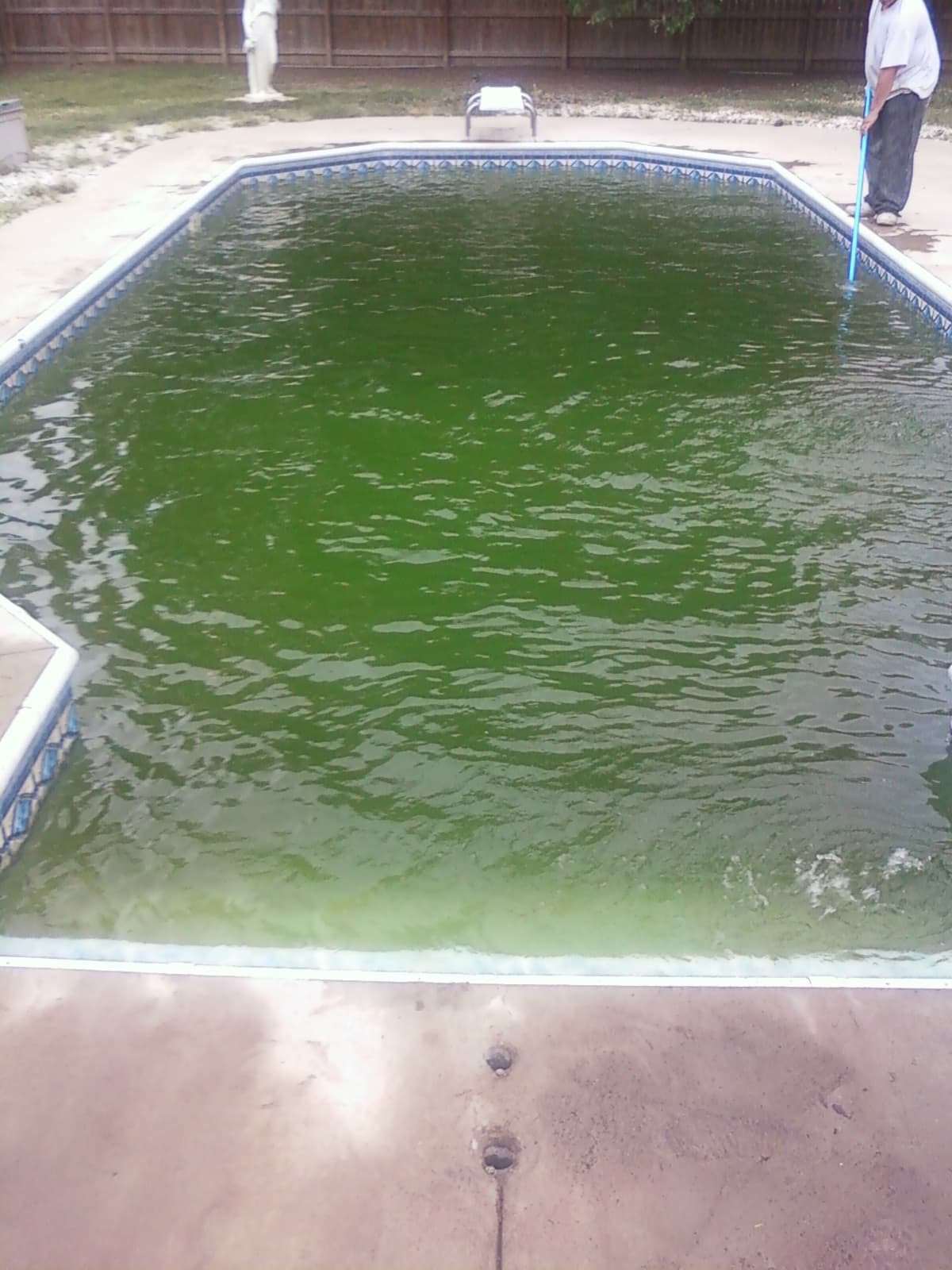
Every summer, right about the time DFW hits its stretch of 100-degree days, the green pool calls start stacking up. It isn't bad luck. Texas heat changes pool chemistry in ways that quietly disable the systems keeping algae out — and by the time the water tints, the pool has usually been losing the fight for a week or two. Here's what's actually happening, what a real recovery involves, and why some pools bounce right back to green.
Why DFW pools turn in the heat
Four things gang up on a North Texas pool in July. First, hot water burns chlorine: at 95–100°F water temperatures, sunlight and heat can consume most of a day's chlorine before evening, so a dose that held fine in May disappears by 3 p.m. in August. Second, stabilizer lockup: cyanuric acid (CYA) protects chlorine from sunlight, but it accumulates with every tablet — and when CYA climbs too high, the chlorine that's technically in the water is too tied up to kill anything. Third, phosphates: spring's live-oak catkins and every storm's runoff load the water with algae food that doesn't leave on its own. Fourth, circulation: pump runtimes that made sense in April are too short for August, leaving dead spots where algae seeds first.
Multifamily pools get a fifth factor — bather load. A packed amenity pool on a Saturday adds sunscreen, sweat, and organics that spike chlorine demand exactly when heat is already eating the residual.
What real recovery looks like
- Assess first: a light green tint and a black-green swamp are different jobs with different timelines — and different price tags
- Physically remove what you can: brush walls and floor, vacuum settled algae, empty baskets — chlorine shouldn't be wasted killing what a brush removes
- Shock to breakpoint based on actual measured demand, not a bag-count guess — and account for CYA level when dosing
- Run filtration continuously through recovery, cleaning or backwashing the filter as it loads with dead algae — a full filter stalls everything
- Rebalance at the end: pH, alkalinity, and stabilizer brought into range so the chlorine that remains actually works
- Typical timeline: 2–4 days for a moderate green, up to a week-plus for a full swamp with heavy debris

Why pools go green again two weeks later
A pool that clears and then re-greens almost always still has the underlying cause in place. The usual suspects: phosphates never addressed, so the surviving algae had a full pantry; the filter wasn't deep-cleaned after recovery, so it re-seeded the pool with what it caught; CYA still sky-high, so the chlorine residual is decorative; or pump runtime went back to its old schedule and the dead spots came back. Recovery without a cause-fix is a subscription to green water.
This is the difference between a shock-and-run service and an actual recovery: the last step is changing whatever let the bloom start — runtime, cadence, chemistry, or filtration — so it doesn't restart.
The commercial stakes are higher
For an apartment or HOA pool, green water isn't just ugly — it's a compliance issue. State rules require the pool bottom and main drain to be clearly visible; a pool that fails that test is subject to closure, and in most DFW cities a closed pool means a re-inspection fee and paperwork before it can legally reopen. Meanwhile residents are photographing the green pool for the community Facebook group. When an amenity turns mid-season, speed matters: emergency chemistry correction, continuous filtration, and a documented reopen. That's a service call we build routes around in July and August.
Keeping it from happening
- Summer-tune the pump schedule: August needs more turnover than April
- Watch chlorine demand weekly in peak heat — consumption doubling is the early warning, not the green tint
- Manage CYA before it manages you: track it, and dilute when it drifts high
- Test and treat phosphates after catkin season and major storms
- For salt pools: check cell output in peak heat — a scaled cell quietly under-produces right when demand peaks
- For amenity pools: weekend chemistry checks during heavy-use months catch Saturday's bather load before Monday's bloom